
.png)
Discover how ePOWR uses automated forecasting, Day-Ahead trading, and real-time imbalance markets to effortlessly maximise your energy savings.
The three stages of ePOWR
ePOWR operates via a three-step process: forecasting, purchasing in advance on the Day-Ahead Market, and balancing on the imbalance market. Each step is tailored to your individual situation and your flexible appliances.
Step 1: It starts with forecasting
FlexiO continuously forecasts what will happen over the next three days. The EMS+ takes the following into account:
- Your consumption. Based on your habits and foreseeable needs.
- Your generation. Based on weather forecasts and your available solar panels.
- Energy prices. Macro-forecasts of supply and demand on the wholesale markets.
- How your flexible appliances are used. When solar panels temporarily reduce output, when your battery will charge or discharge, when EV charging slows down or speeds up. All with one goal: to minimise your total energy costs.
- When and how much you will buy or sell to the grid. This is your pre-planned consumption and feed-in.
Step 2: The Day-Ahead Market: buying a day in advance
At around 8.30 am on the day before delivery, FlexiO takes a snapshot of your planned consumption and injection. This is known as your Day-Ahead order: a purchasing strategy for the following day, with volumes specified per quarter-hour.
Important point: at the time the orders are placed, the price is not yet known. It is only published later that day, around 2 pm. FlexiO works with an estimate of what the market will do.
The wholesale markets operate in quarter-hour blocks. A Day Ahead order is therefore not a single amount for the whole day, but 96 separate buying or selling decisions. That order is sent to the market and helps determine the Day Ahead price.
Step 3: The imbalance market: real-time adjustments
Then comes reality. On the day itself, actual conditions are measured every 15 minutes. The real-time price (the imbalance price) is updated every minute and reflects the actual cost of keeping the electricity grid in balance.
In the event of a major shortfall, these prices are high. If demand is too low, they are low, often even negative.
FlexiO continuously forecasts what the real-time energy price will be in the current and the next quarter-hour. Based on this, positions are taken in the imbalance market to buy energy at the lowest possible price and sell it at the highest possible price.
If you buy or sell more energy than Flexio had originally planned for that day, the difference is settled at the imbalance price. In short: your original plan is fixed, but the final bill is adjusted to reflect what actually happened via your meter.
Deviations from that original schedule typically occur in two scenarios:
- FlexiO adjusts its strategy to capitalise on an opportunity. For example: if there is more sunshine than forecast, leading to excessive feed-in to the grid, the imbalance price plummets into negative territory. FlexiO charges your battery instead of feeding solar production into the grid. Result: you are paid the high negative amount for the kWhs you did not feed in, and you retain the Day Ahead price for what you originally sold.
- FlexiO can no longer adjust. The same example, but the battery is now full, the solar panels cannot be switched off, so the surplus production on that extra sunny day is sold at the imbalance price. We are then dealing with a ‘forecasting error’.
There is more activity on the imbalance market than on the Day-Ahead Market. For those with flexible capacity that FlexiO can manage, this is where the best opportunities lie for reducing energy bills.
Billing in a nutshell
At the end of each month, all volumes bought and sold in each quarter-hourly period are multiplied by the price applicable at that time. These figures are then added together. This gives the total amount you are due to pay to, or receive back from, the energy market.
How does this official settlement take place?
Your digital meter measures your actual consumption and feed-in volumes from the grid every 15 minutes. The distribution system operator (Fluvius, in Flanders) is responsible for collecting this data and making it available to the energy supplier.
The difference between this measured energy volume and the volume bought and sold on the Day-Ahead Market becomes the volume you buy and sell on the imbalance market.
You typically buy and sell larger volumes than the actual consumption and feed-in measured by the network operator (to and from the grid). Let’s revisit the example above (there is more sunshine than forecast): During that sunny quarter of an hour, 1kWh was sold to the grid at 2c/kWh on the Day Ahead market. In reality, you appear to be generating 1.5 kWh with your solar panels, but you store all of this in your battery. At that moment, therefore, absolutely nothing (0 kWh) is passing through your digital meter. So, for that quarter of an hour, you do not sell the planned 1 kWh (because there is already too much supply on the grid due to the sunny day), so you have to buy it at the imbalance price (say -10c/kWh) to balance the books. End result: you have traded 2 kWh (1 sold on the Day Ahead and 1 bought) and you receive 12c for it, whilst nothing has passed through your meter.
From market result to invoice: the ePOWR credit
Your bill consists of two parts:
- The energy cost. This is what you pay for the electricity you purchase, minus any credit for electricity you feed into the grid, in accordance with your tariff terms.
- Distribution costs and taxes. Fees for network operators and the government. Partly fixed, partly dependent on consumption (kWh) and peak power.
Let’s take an example: on 24 April, a customer’s supply bill looked like this:
| Grid take off / grid injection | 0.75 kWh / 17.75 kWh |
| delivery bill (all-in) | 0,62 EUR |
| part A (energy) | 0,09 EUR |
| part B (distribution + taxes) | 0,53 EUR |
However, his actual trading result was not a payment of €0.09. Due to the adjustment, the customer receives €-0.34 from the market. His bill must therefore be reduced by the difference between these amounts (€0.43). This is the ePOWR credit: the adjustment needed to match your supply bill with your trading result.
Want to know more? Read here how your MyPOWR price is calculated.
No risk to you: the safety net explained
Access to the electricity markets does, in principle, involve a risk. On an exceptional day, prices can fluctuate wildly. What if your positions are unfavourable for a whole week?
The answer is simple: that risk is not yours to bear. It is borne by your energy supplier and LIFEPOWR.
If your actual market result for a given period is not more favourable than your supply bill, the ePOWR adjustment is capped at 0. It will never result in an additional cost.
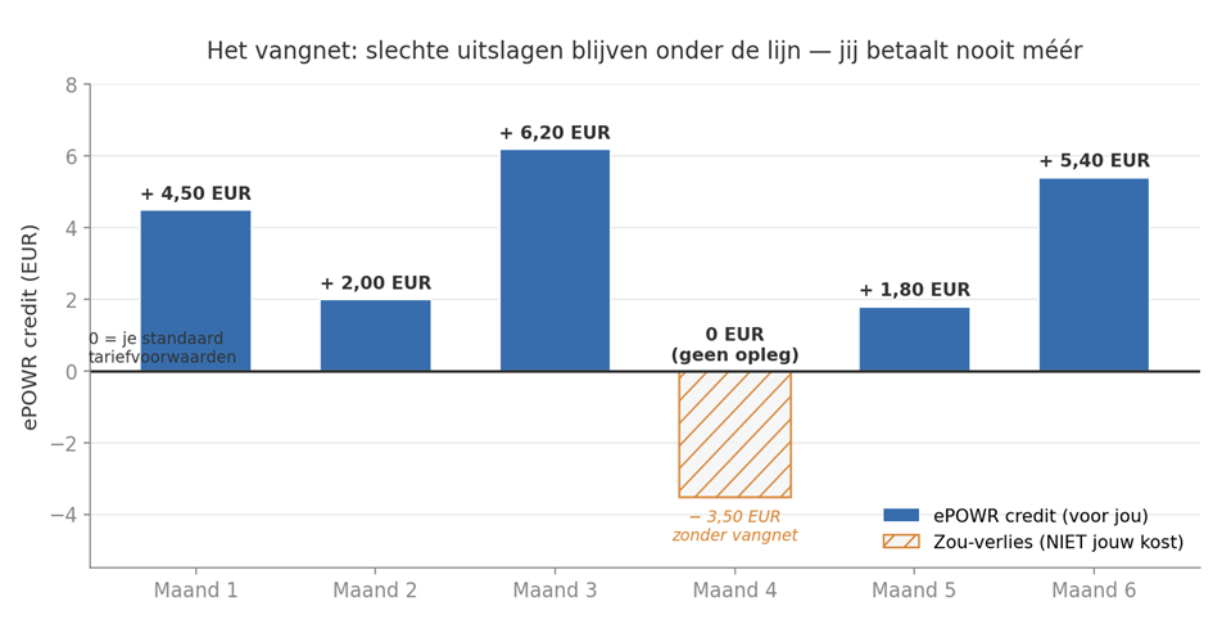
In other words:
- Was your market position more favourable than your standard tariff terms? You’ll receive the difference as an ePOWR credit.
- Was your market position less favourable? The ePOWR credit will be 0. So you simply pay your supply bill, nothing more.
An ePOWR credit of 0 does not mean you save nothing. You still retain:
- The saving compared to the original bill (sun and FlexiObesparing).
- Your rPOWR payouts, if you participate in them, which are separate from the ePOWR credit.
Are you also taking part in rPOWR?
For customers who are also active on rPOWR, Elia’s basic principles regarding balancing reserves continue to apply. In addition to actively trading your positions, the system takes into account the need to keep a portion of your battery capacity available in return for a fee.
That fee must be higher than the predicted opportunity cost; in other words, higher than what the same battery capacity could have yielded elsewhere through smart trading on ePOWR. Only then is it worth reserving the capacity for rPOWR.
In this way, FlexiO continuously selects the most valuable application for your flexibility: ePOWR when it yields the highest return, rPOWR when the reservation fee is more attractive.
How can you increase your chances of getting a better deal?
Practical tips:
- Let as many of your assets as possible be controlled automatically. The more flexible the system is, the better we can manage it for you at the right times. Charging your car, in particular, can have a significant impact.
- Charge your EV in Smart or ECO mode. Manual or preset charging sessions miss out on precisely those moments that make all the difference. These modes follow the imbalance price incentive and maximise your charging speed when prices are extremely negative, or pause charging when prices are very high.
- Bear in mind the imbalance and do not follow the Day-Ahead price. Do you wish to base your behaviour on price incentives? Do not forget about imbalance. Particularly on exceptional days, it is the imbalance price that makes the difference; basing your behaviour on the Day-Ahead price incentive can backfire. You can view the imbalance price on the Elia website.
- Avoid manual intervention in battery control. Every override limits the system’s optimisation range.
Put your trust in the power of automation and let the system do the work for you. With the right settings, you can effortlessly turn your energy consumption into maximum financial savings.

